
Dr. Ahmed Gadallah

Total Hip Replacement in Cairo · THR

Restoring the hip joint. Returning to confident movement.

Total hip replacement reconstructs a severely damaged ball-and-socket joint using carefully selected implant components. The decision to operate is based on the diagnosis, symptoms, joint damage, function and the individual goals of each patient.
Hip Arthroplasty Implant Planning Leg Length & Stability Structured Rehabilitation
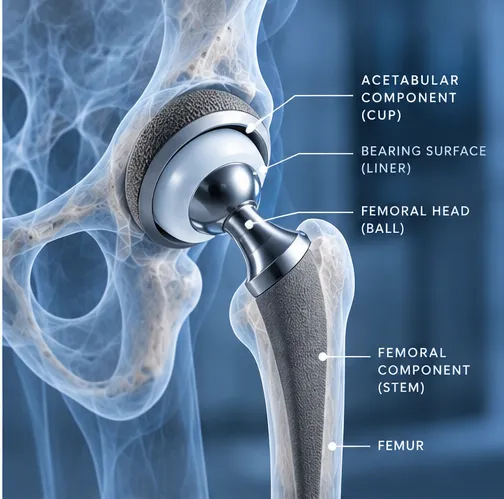
Total hip replacement implant components: acetabular cup, liner, femoral head and femoral stem
Hip Reconstruction Cup. Stem. Stability. Surgical planning is adapted to the individual hip.
Procedure Total Hip Arthroplasty
Purpose Reconstruct the damaged ball and socket
Hospital Care Planned individually
Rehabilitation Integrated into recovery
Follow-Up Planned according to recovery
The Surgical Decision

Hip replacement starts with the right indication.

Surgery may be considered when significant hip damage, most commonly from osteoarthritis, avascular necrosis of the femoral head, inflammatory arthritis, previous injury or hip dysplasia, causes persistent pain and functional limitation that appropriate non-surgical treatment no longer controls.

01
Symptoms Groin or hip pain, stiffness and night pain are considered in the assessment.
02
Imaging X-rays, and MRI when needed, define the damage to the joint and femoral head.
03
Function Walking distance, stairs, sitting and putting on shoes form part of the decision.
04
Previous Treatment The response to appropriate non-surgical treatment also matters.
Understanding THR

The worn ball and socket are replaced.

Total hip replacement reconstructs both sides of the joint: a cup is fixed in the pelvic socket and a stem with a new ball is fixed in the thigh bone, with a smooth bearing surface between them.

Labelled total hip replacement components
01 Acetabular Cup Reconstructs the worn socket in the pelvis.
02 Bearing Liner Forms the smooth moving surface inside the cup.
03 Femoral Head The new ball that moves within the socket.
04 Femoral Stem Fixed within the thigh bone to support the new ball.
Planning & Precision

The reconstruction is planned before it is performed.

Total hip replacement involves decisions about implant size, cup and stem position, leg length, hip offset, fixation and joint stability. Each of these affects how the new hip feels and functions.

Implant Size Selected according to patient anatomy.
Cup & Stem Position Orientation forms part of the operative plan.
Leg Length & Offset Planned to restore balanced hip mechanics.
Fixation & Stability Cemented or uncemented fixation is chosen individually.
Plan → Verify → Execute
Your Surgical Pathway

From assessment to recovery.

Hip replacement is a process rather than a single event. Assessment, preparation, surgery, early mobility, rehabilitation and follow-up each form part of the pathway.

01
Assessment Diagnosis, examination and imaging.
02
Preparation Medical preparation and surgical planning.
03
Surgery The ball and socket are reconstructed.
04
Early Mobility Walking with support begins according to the plan.
05
Rehabilitation Strength, balance and gait progress.
06
Follow-Up Recovery is monitored after surgery.
Rehabilitation after total hip replacement
After Surgery

Recovery progresses step by step.

Rehabilitation after total hip replacement focuses on safe walking, protecting the new joint, rebuilding hip strength and returning to daily activity. The exact pathway is individualized according to the patient, procedure and rehabilitation progress.

Mobility Walking with support.
Protection Movement advice for the new hip.
Strength Rebuilding hip and leg muscles.
Function Returning toward daily activity.
Recovery timelines vary between patients. Progression is guided according to the individual surgical and clinical situation.
Safety & Informed Decision-Making

A balanced decision includes benefits, limitations & risks.

Total hip replacement is a major operation. The expected benefits and relevant risks should be considered together before proceeding.

What Surgery Aims to Address

Function after a damaged hip.

01
Pain Replacement aims to address pain arising from a severely damaged hip joint.
02
Mobility The reconstruction is planned to support walking and hip movement.
03
Daily Function Recovery focuses on returning toward useful everyday activity.
What We Discuss Before Surgery

Relevant surgical considerations.

Infection Blood Clots Dislocation Leg-Length Difference Bleeding Implant-Related Problems Anaesthetic / Medical Risks

Individual risk varies according to general health, medical history, the condition of the hip and the surgical situation. Relevant risks and expected benefits are discussed during pre-operative assessment.

Dr Ahmed Gadallah orthopedic surgeon
Your Surgeon

Hip replacement guided by dedicated arthroplasty training.

Dr. Ahmed Gadallah's orthopedic practice includes joint replacement, trauma and reconstructive surgery. In 2026 he completed the EPHAKS Master Class in Total Hip Arthroplasty, covering complex primary and revision hip replacement, together with a hands-on primary hip arthroplasty cadaveric course at Ain Shams University. He holds an MSc in Orthopedic Surgery from Cairo University and is undertaking ongoing PhD studies there.

Hip Arthroplasty Training EPHAKS Master Class in THA · Complex Primary & Revision · 2026
Hands-On Training Primary Hip Arthroplasty Cadaveric Course · Ain Shams · 2026
Postgraduate Degree MSc Orthopedic Surgery · Cairo University
Current Studies Ongoing PhD Studies · Cairo University
International orthopedic patient care in Cairo
HOME Initial Contact
CAIRO Arrival
ASSESS Clinical Review
SURGERY Hospital Care
RECOVER Rehabilitation
RETURN Follow-Up
International Patients · Surgery in Cairo

Travelling to Egypt for hip replacement?

International patients can arrange assessment, treatment planning and surgical care with Dr. Gadallah. Practical support surrounding the medical pathway can also be coordinated according to the individual treatment plan.

Consultation & Treatment Planning
Hospital Coordination
Accommodation Options
Physiotherapy Coordination
Post-Operative Support
Family-friendly Apartments
Common Questions

Understanding hip replacement.

When should total hip replacement be considered? +
Total hip replacement may be considered when significant hip damage causes persistent pain and functional limitation and appropriate non-surgical treatment is no longer providing sufficient control. The decision is individualized.
What exactly is replaced during total hip replacement? +
Both sides of the joint are reconstructed: a cup with a smooth liner is placed in the pelvic socket, and a femoral stem with a new ball is placed in the thigh bone.
Can hip replacement treat avascular necrosis (AVN)? +
When avascular necrosis has led to collapse of the femoral head and damage to the joint, hip replacement is one of the treatment options. Earlier stages may be managed differently, so imaging and assessment guide the decision.
What is the difference between cemented and uncemented hip replacement? +
Cemented implants are fixed with bone cement, while uncemented implants rely on bone growing onto the implant surface. The choice depends on factors such as age, bone quality and anatomy.
When can I begin walking after surgery? +
Early walking with support commonly forms part of postoperative care, but the timing and level of activity depend on the individual patient, procedure and clinical condition.
Is dislocation a risk after hip replacement? +
Dislocation is one of the recognised risks. Implant positioning, soft-tissue repair and movement advice during recovery all aim to reduce it, and the specific precautions are explained before discharge.
How long can a hip replacement last? +
Modern implants are designed for long-term use, but no implant has a guaranteed lifespan. Longevity varies according to the implant, fixation, activity and individual patient factors.
Total Hip Replacement

Understand your hip before deciding on surgery.

Arrange an orthopedic assessment with Dr. Ahmed Gadallah to review your symptoms, imaging and treatment options and determine the most appropriate pathway for your hip.